
Frankincense Resin vs. Essential Oil: Why the Form Matters
Frankincense is usually discussed as though the word describes one ingredient.
It does not.
The aromatic material known as frankincense begins as an oleo-gum-resin produced by trees in the Boswellia genus. That resin can then be used in very different ways. It can remain raw. It can be steam-distilled into essential oil. It can produce a hydrosol during distillation. It can also be processed into a resin-derived extract.
Those materials share a botanical origin, but they do not share the same composition.
That distinction is one of the reasons Alchemy Elements became so interested in frankincense in the first place.
Start with the resin
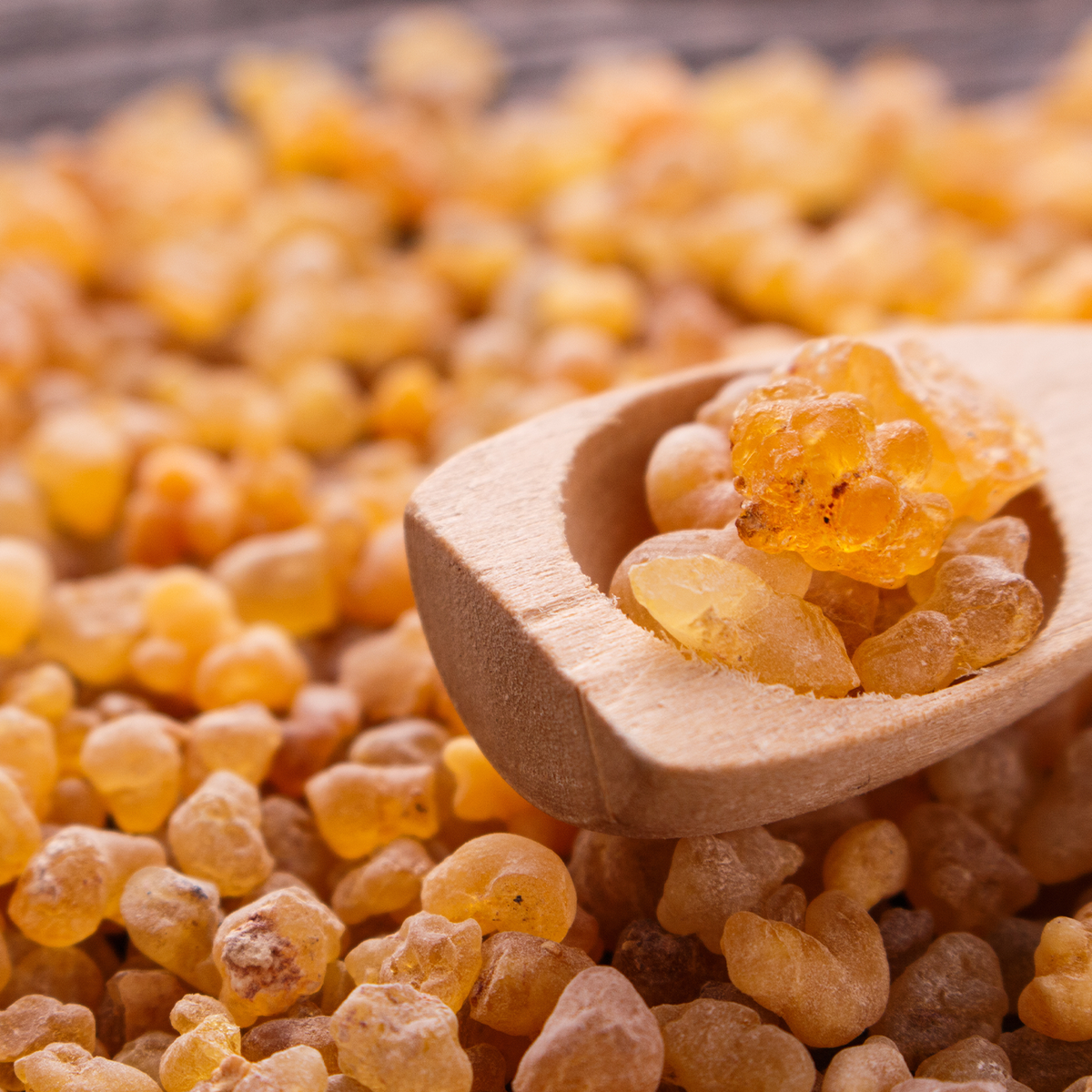
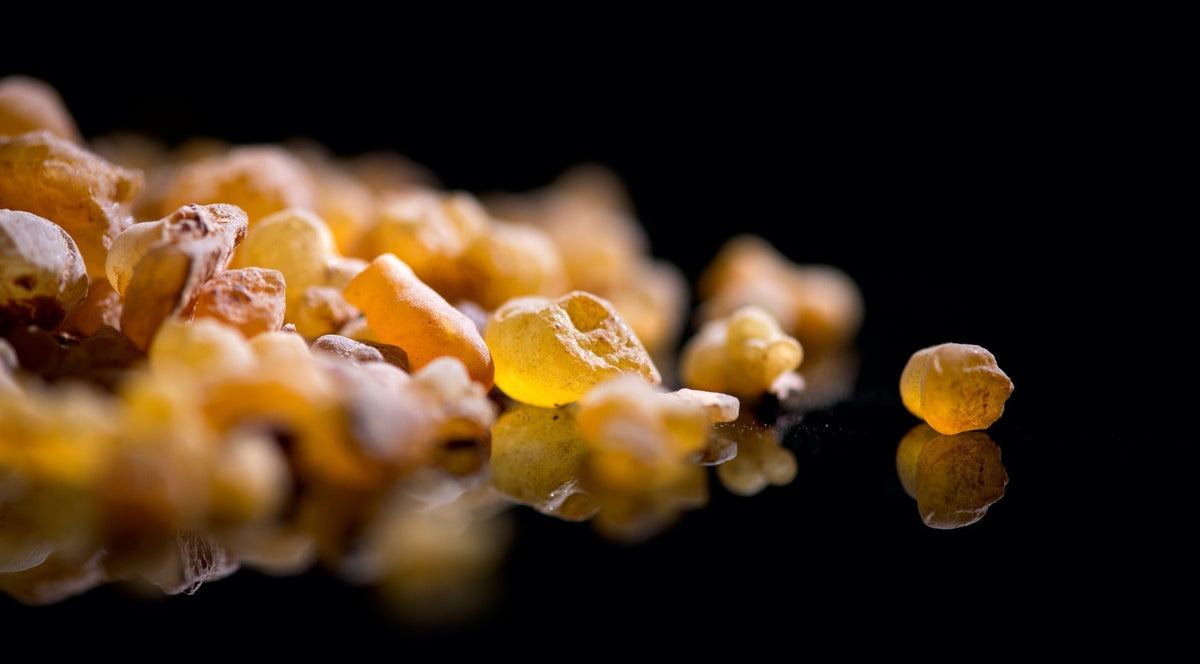
Frankincense resin forms when Boswellia trees exude a sticky material that hardens into the familiar resin tears traded for centuries.
The resin itself is chemically complex. Reviews of Boswellia sacra describe multiple classes of constituents in the oleo-gum-resin, including volatile aromatic compounds as well as less-volatile resin components such as boswellic acids and related triterpenes.
That entire resin matrix is the starting material.
What happens next determines what kind of frankincense ingredient you actually have.
Essential oil is one fraction of frankincense
Frankincense essential oil is produced through distillation.
Distillation favors volatile compounds: molecules that can travel with steam and then condense into the aromatic oil fraction. Analyses of frankincense essential oils commonly identify volatile terpenes such as alpha-pinene and other aroma-bearing constituents.
That makes the essential oil useful for fragrance, sensory character, and other formulation purposes.
But an essential oil should not be treated as a miniature version of the whole resin.
The heavier, nonvolatile portion of the resin does not simply distill over with the aromatic fraction.
This is why saying a product “contains frankincense” does not tell you enough to understand what material is actually present.
Where boswellic acids fit
Boswellic acids are triterpenoid constituents associated with the resin portion of Boswellia materials.
They are frequently discussed in research involving resin extracts, particularly oral or laboratory preparations. They should not be casually attributed to steam-distilled frankincense essential oil.
That distinction matters.
If the formulation goal is to work with constituents associated with the resin itself, the preparation method has to make sense for those constituents.
This does not make the essential oil inferior. It makes it different.
The useful question is not:
Which form is better?
The useful question is:
Which form is actually being used, and why?
Raw resin, essential oil, hydrosol, and resin-derived extract
Raw frankincense resin
The original oleo-gum-resin collected from the tree.
It contains the broader resin matrix before a particular separation or preparation method is applied.
Frankincense essential oil
The volatile aromatic fraction produced through distillation.
Its composition is dominated by volatile constituents and can vary by species, geography, individual tree, harvest, and distillation conditions.
Frankincense hydrosol
The water-based aromatic distillate collected alongside essential oil during hydrodistillation or steam distillation.
It is not simply essential oil diluted in water. It is its own water-based distillation material.
Resin-derived extract
A preparation designed to work with material from the resin through an extraction process rather than relying only on distillation or simple oil infusion.
The exact composition depends heavily on the extraction method.
This is the category that eventually led Alchemy Elements to develop Resin-Crafted™.
Why Alchemy moved beyond infusion
A simple oil infusion can be useful when oil-soluble material transfers effectively into the carrier oil.
But “frankincense-infused oil” and “frankincense resin extract” should not be treated as interchangeable phrases.
When we began looking more closely at frankincense, the problem was not that essential oil or infusion had no place in skincare.
The problem was that the language around frankincense often collapsed very different preparations into a single ingredient story.
We wanted to work more deliberately with the resin itself.
That work became Resin-Crafted™, our proprietary extraction-and-refinement approach to creating refined, resin-derived botanicals for modern skincare.
Frankincense was the first major expression of that approach.
Why this matters when reading a skincare label
Ingredient literacy becomes much easier when you stop asking only:
Does this product contain frankincense?
and start asking:
- What form of frankincense?
- What species?
- What part of the material is represented?
- How was it prepared?
- What role does that form play in the finished formula?
The same principle applies far beyond frankincense.
Sea buckthorn fruit oil is not sea buckthorn seed oil.
A hydrosol is not an essential oil.
Jojoba is commonly called an oil, but chemically it is predominantly a liquid wax.
An extract is not automatically equivalent to a whole plant, infusion, or distillate.
The name of the plant is only the beginning.
The point is precision, not hierarchy
Material distinctions should not become another way to declare one ingredient universally superior to another.
Essential oil can be the correct choice when a formula needs that aromatic, volatile fraction.
A hydrosol can be useful when a water-based distillation material fits the formula.
A resin-derived extract can be appropriate when the formulation is intentionally working with the resin through a different preparation route.
Good formulation begins by understanding which material is actually in your hands.
That is the distinction that matters.
Related reading
Sources & References
- Al-Harrasi A, et al. Taxonomical Investigation, Chemical Composition, Traditional Use in Medicine, and Pharmacological Activities of Boswellia sacra Flueck. Molecules. 2022. https://pmc.ncbi.nlm.nih.gov/articles/PMC8881160/
- Ojha PK, et al. Comparison of Volatile Constituents Present in Commercial and Lab-Distilled Frankincense (Boswellia carteri) Essential Oils for Authentication. Plants. 2022. https://pubmed.ncbi.nlm.nih.gov/36015437/
- DeCarlo A, et al. Compositional analysis of the essential oil of Boswellia dalzielii frankincense from West Africa reveals two major chemotypes. Phytochemistry. 2019. https://pubmed.ncbi.nlm.nih.gov/31071599/
- Qualitative and quantitative analyses of the changes in the chemical composition of frankincense before and after stir-frying using GC-MS and LC-MS. Analytical Methods. 2025. https://pubmed.ncbi.nlm.nih.gov/39963767/

Written by Brenden Scott




1 comment
Hello from Australia, lm wondering if you sell this product anywhere in Australia?
Cheers
Heather
Heather
Leave a comment
This site is protected by hCaptcha and the hCaptcha Privacy Policy and Terms of Service apply.