
Article: Why Ingredient Form Matters
Why Ingredient Form Matters
Ingredient lists can look deceptively simple.
Jojoba oil.
Frankincense.
Sea buckthorn.
Chamomile.
Vitamin E.
Those names feel specific until you look closer.
Which part of the plant?
Which preparation?
Which chemical form?
Which extraction?
Which solvent or carrier?
Which fraction?
Which INCI?
Once those questions begin, the same ingredient name can open into several materially different possibilities.
That is why ingredient form matters.
A plant is not one ingredient
Plants contain many types of material distributed across different tissues and structures.
The seed is not the fruit.
The peel is not the flower.
The volatile oil is not the resin.
A water distillate is not an essential oil.
An extract is not automatically equivalent to the whole plant.
Skincare language often compresses those distinctions because broad plant names are easier to market.
Formulation cannot afford to be that vague.
Sea buckthorn: one plant, two very different oils
Sea buckthorn is a useful example.
The plant produces oil-rich material in both its seeds and its fruit pulp.
Those oils differ.
Reviews comparing sea buckthorn fractions describe seed oil as richer in polyunsaturated fatty acids such as linoleic and alpha-linolenic acids, while pulp or fruit oil contains substantially more palmitoleic acid and carotenoid-rich pigment.
Same plant.
Different plant part.
Different lipid profile.
Different color.
Different material character.
Calling both simply “sea buckthorn oil” hides information that actually matters.
This is why Alchemy identifies Sea Buckthorn Fruit Oil specifically when that is the material being used.
Jojoba: called an oil, structured like a liquid wax
Jojoba creates a different kind of naming problem.
It is commonly called jojoba oil.
That name is convenient, but chemically the material is predominantly a liquid wax made from long-chain wax esters.
That structure is unusual among familiar botanical carrier oils, which are typically dominated by triglycerides.
The practical lesson is not that everyone needs to become a lipid chemist.
It is that familiar category words can obscure useful differences.
“Oil” describes how jojoba behaves in everyday use.
“Liquid wax” tells you more about what the material actually is.
Both pieces of information are useful.
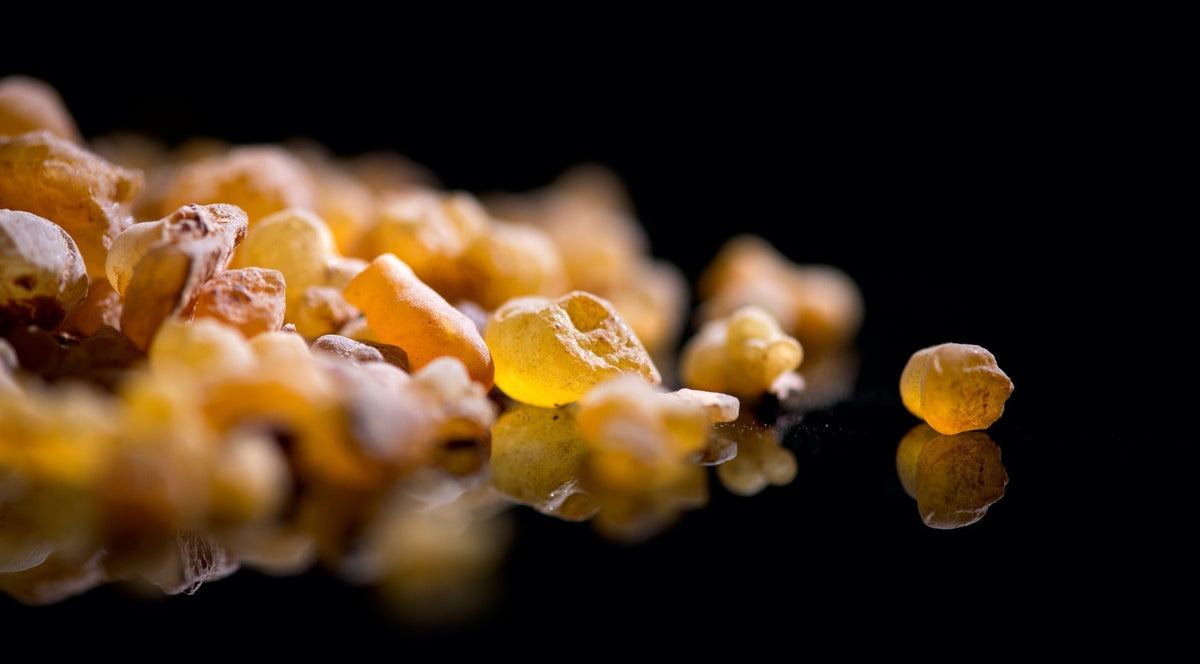
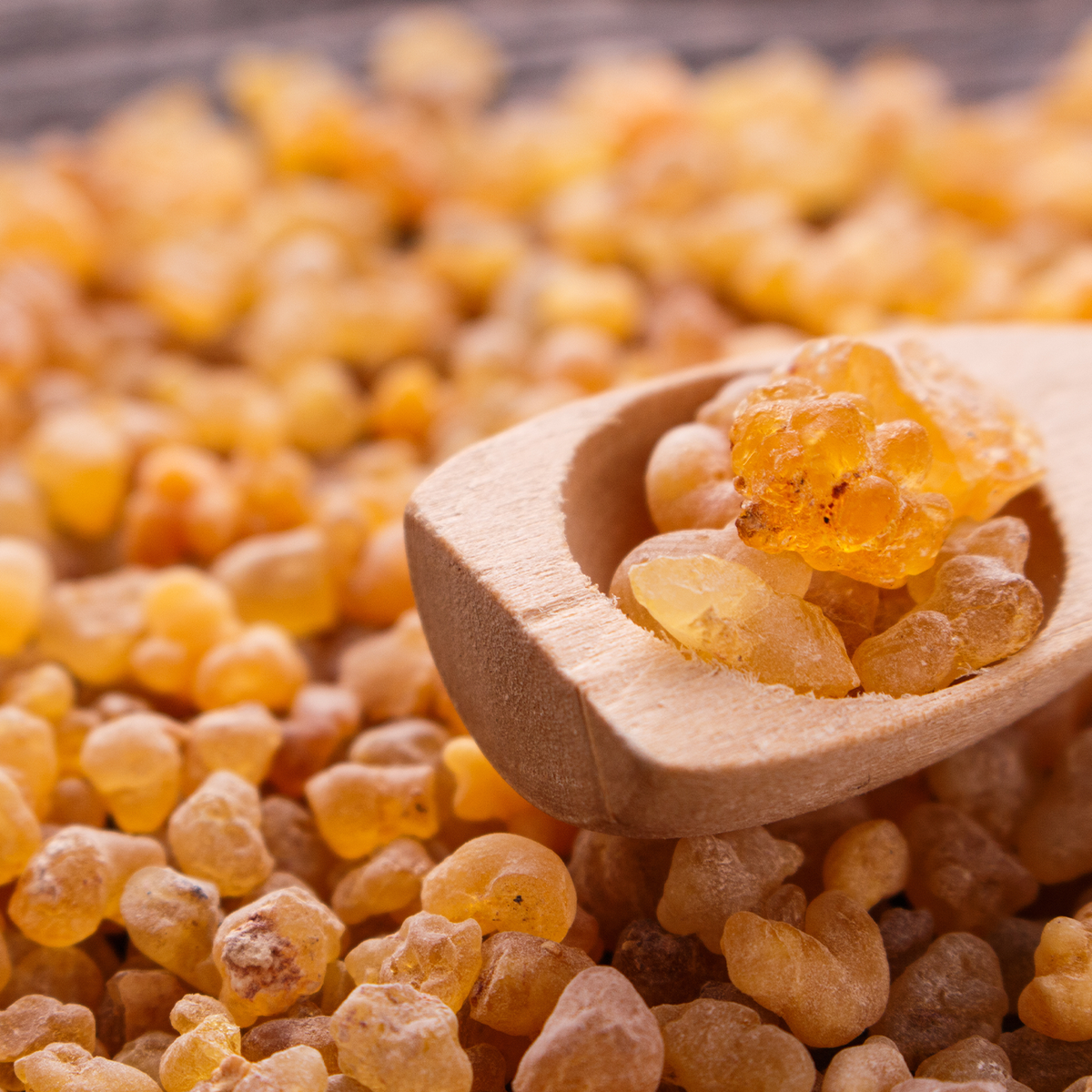
Frankincense: resin is not essential oil
Frankincense pushes the concept further.
The original botanical material is an oleo-gum-resin produced by Boswellia trees.
Distillation produces an essential oil composed of volatile aromatic constituents.
The resin itself contains a broader set of material, including heavier nonvolatile constituents that do not simply become part of the distilled essential oil.
A hydrosol represents another water-based distillation fraction.
A resin-derived extract represents another preparation again.
So a label that says “frankincense” is incomplete from a formulation perspective.
The more useful question is:
What form of frankincense?
That question eventually became central to the development of Resin-Crafted™.
Extraction changes what enters the formula
Extraction is not merely a manufacturing step that happens in the background.
It determines what material is being separated, concentrated, transferred, or excluded.
Water favors some constituents.
Oil favors others.
Alcohol can interact with another range of compounds.
Steam distillation is designed around volatile material.
Mechanical pressing physically removes oil from oil-bearing plant material.
These are not interchangeable operations.
Changing the preparation can change what ultimately enters the formula.
That is why two products can list ingredients derived from the same plant while containing very different material fractions.
Form also matters for non-botanical ingredients
The principle is not limited to herbs and oils.
“Tocopherol” and “tocopheryl acetate” are related materials but not identical ingredients.
Hyaluronic acid, sodium hyaluronate, and hydrolyzed sodium hyaluronate are related names that refer to distinct material identities or preparations.
Magnesium chloride and magnesium sulfate are different salts.
Ingredient literacy improves when category names stop replacing specific identities.
INCI helps, but it does not answer everything
The International Nomenclature of Cosmetic Ingredients gives formulators and customers a standardized language for cosmetic ingredient labeling.
That is useful.
An INCI name can help distinguish materials that marketing language blurs together.
But INCI still does not necessarily tell you:
- supplier grade
- concentration
- extraction solvent
- standardization
- geographic source
- purity specification
- processing history
- particle size
- molecular-weight distribution
- or every relevant physical characteristic
Ingredient identity has layers.
The label is a starting point.
Why this changes the way we formulate
At Alchemy Elements, we try to begin with purpose rather than ingredient collecting.
What are we building?
What should the finished formula feel like?
What role needs to be filled?
Then:
Which material form actually makes sense?
This prevents a common formulation trap: assembling a long list of recognizable ingredient names simply because each one has a desirable reputation.
A material should have a reason to be there.
And that reason should make sense in the form actually being used.
More ingredients do not automatically make a better formula
A long ingredient list can look impressive.
That does not mean the formula is better designed.
Adding multiple versions of similar materials, fashionable botanicals, or trace amounts of recognizable actives can make a label more marketable without necessarily improving the finished system.
Formulation is relational.
Materials affect:
- texture
- spread
- stability
- preservation
- solubility
- oxidation
- sensory experience
- compatibility
- packaging
- and one another
The question is not how many attractive ingredients can fit on a label.
The question is whether the materials make sense together.
“Natural” and “synthetic” are not enough either
“Natural” does not tell you whether an ingredient is appropriate for a formula.
“Synthetic” does not tell you that it is inappropriate.
A material can be naturally derived and irritating in a particular context.
A synthetically produced ingredient can be well-characterized, highly functional, and appropriate for the formula.
Origin matters.
Processing matters.
Safety matters.
Function matters.
Compatibility matters.
The binary label often tells you less than people think.
How to read an ingredient more intelligently
1. What is the actual ingredient?
Look beyond the marketing name when possible.
2. What form is it in?
Oil, extract, hydrosol, essential oil, salt, ester, powder, wax, ferment, or another preparation?
3. What part or source does it come from?
Seed, fruit, flower, leaf, bark, resin, mineral source, fermentation substrate?
4. What role does it play?
Emollient, humectant, preservative, antioxidant, surfactant, fragrance material, solvent, active, thickener?
5. Why is it in this formula?
That final question is where ingredient literacy becomes formulation literacy.
The name is only the beginning
We built the Material Library around this idea.
Not because every customer needs to memorize cosmetic chemistry.
Because clearer distinctions lead to better questions.
And better questions make it harder for marketing language to do all the thinking for us.
A plant name is not a complete ingredient identity.
An ingredient identity is not a complete formula.
The closer you look at the material, the clearer the formulation becomes.
Related reading
- Explore the Material Library → Material Library
- Frankincense Resin vs. Essential Oil: Why the Form Matters → Journal
- Explore Resin-Crafted™ → Resin-Crafted™ page
Sources & References
- Meier L, Stange R, Michalsen A, Uehleke B. Jojoba in dermatology: a succinct review. 2014. https://pubmed.ncbi.nlm.nih.gov/24442052/
- From Nutritional Profile to Circular Bioeconomy: A Review of Sea Buckthorn Oil and By-Product Valorization. 2026. https://pmc.ncbi.nlm.nih.gov/articles/PMC13256188/
- The impact of sea buckthorn oil fatty acids on human health. 2019. https://pmc.ncbi.nlm.nih.gov/articles/PMC6589177/
- Al-Harrasi A, et al. Taxonomical Investigation, Chemical Composition, Traditional Use in Medicine, and Pharmacological Activities of Boswellia sacra Flueck. 2022. https://pmc.ncbi.nlm.nih.gov/articles/PMC8881160/
- Ojha PK, et al. Comparison of Volatile Constituents Present in Commercial and Lab-Distilled Frankincense (Boswellia carteri) Essential Oils for Authentication. 2022. https://pubmed.ncbi.nlm.nih.gov/36015437/

Written by Brenden Scott




Leave a comment
This site is protected by hCaptcha and the hCaptcha Privacy Policy and Terms of Service apply.