
Frankincense Origin: What Sourcing Can Tell You, and What It Cannot
There are places where a material becomes inseparable from geography.
Frankincense and Oman are one of those relationships.
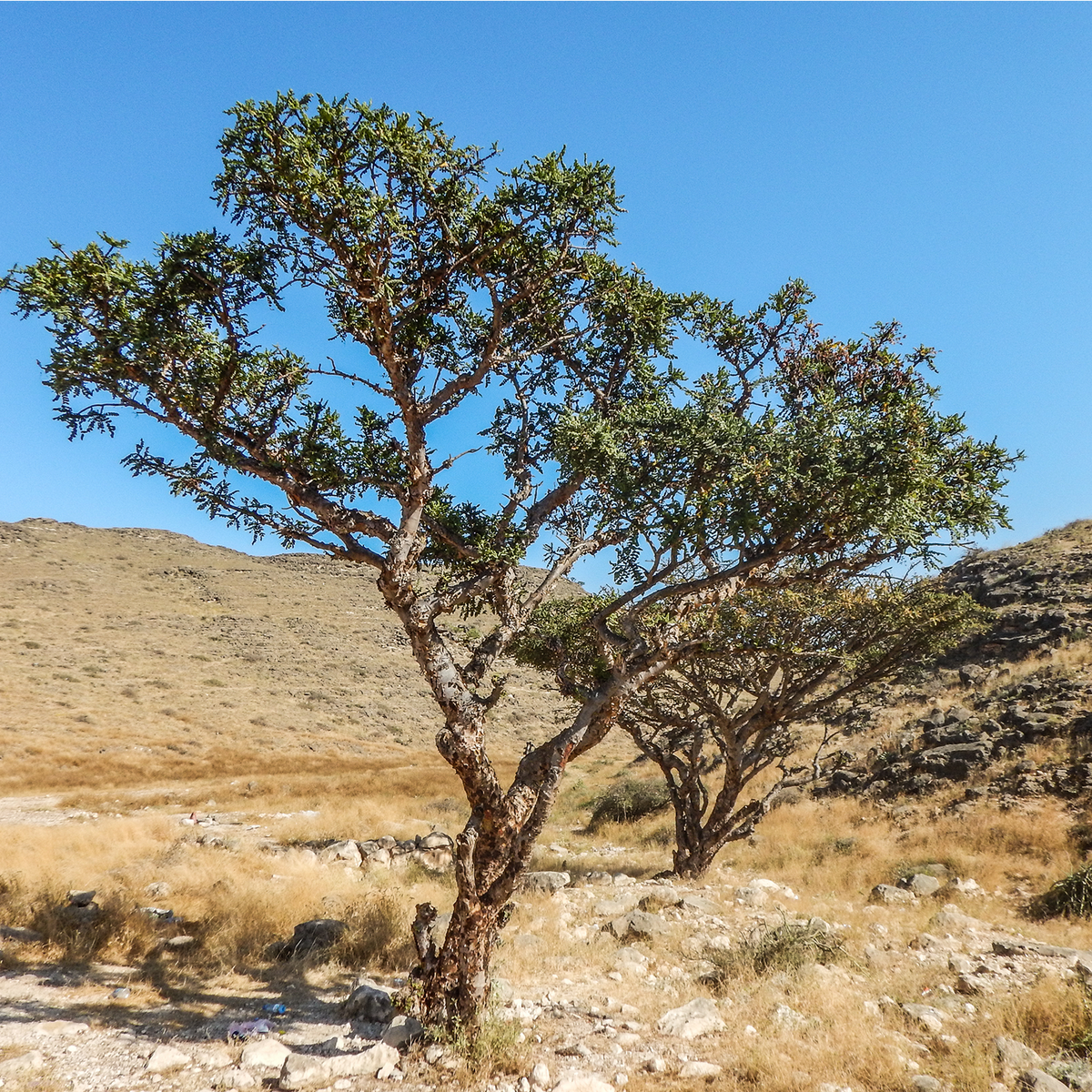
For centuries, frankincense moved through southern Arabia as a valuable trade material. Today, the UNESCO-listed Land of Frankincense in Oman preserves archaeological sites connected with that history, along with Wadi Dawkah, where Boswellia sacra trees still grow.
That history matters.
But when frankincense enters a modern skincare formula, origin is not the whole story.
A place name can tell us something important about a material. It cannot tell us everything.
Oman and Boswellia sacra
Boswellia sacra is one of the frankincense-producing species associated closely with Oman and the wider Arabian Peninsula.
The trees are adapted to severe environments. In Dhofar, they grow under heat, low rainfall, rocky conditions, and seasonal weather patterns very different from conventional agricultural systems.
Wadi Dawkah is specifically recognized by UNESCO as an important site where Boswellia sacra grows and where frankincense continues to be harvested.
That gives Omani frankincense genuine botanical, cultural, and historical context.
It does not automatically make every resin harvested in Oman chemically identical.
Species matters
“Frankincense” is not one species.
The name can refer to resins from multiple Boswellia species, including Boswellia sacra, Boswellia serrata, Boswellia papyrifera, and others.
Species identity matters because different Boswellia materials can differ in their chemical profiles.
Even within one species, natural variation exists.
That is one reason a label such as “frankincense” is incomplete from a material perspective.
A more useful description asks:
- Which Boswellia species?
- What material form?
- What source?
- What preparation?
- What quality controls?
Geography matters, but it is not a potency score
Origin can affect a botanical material.
Growing conditions, local ecology, climate, harvest practices, post-harvest handling, and supply-chain conditions can all influence what ultimately reaches a formulator.
But geographic prestige can easily turn into marketing shorthand.
Claims such as “the world’s most potent frankincense” sound definitive while skipping the analytical work required to prove them.
A geographic origin does not by itself establish:
- a universal concentration of one constituent
- superior cosmetic performance
- a specific extraction yield
- a specific boswellic-acid profile
- purity
- freshness
- sustainability
- or suitability for a particular formula
Those questions require material-specific evidence.
Harvest and handling matter too
Frankincense resin is obtained by tapping the tree and collecting the exuded material after it hardens.
How often trees are tapped, how resin is collected, sorted, stored, transported, and protected from contamination can all matter downstream.
Those factors are less romantic than ancient trade routes, but they are often more useful to a formulator.
When evaluating a resin, we care about identity and condition, not mythology.
Conservation is part of the sourcing conversation
Frankincense is not an abstract luxury material.
It comes from living tree populations and real landscapes.
UNESCO recognizes the historical and cultural importance of Oman’s Land of Frankincense, including Wadi Dawkah.
Responsible sourcing therefore cannot stop at the word “wild” or “traditional.”
Those terms may describe part of a supply story, but they do not automatically prove sustainability.
Good sourcing requires questions.
What we actually want to know
When Alchemy evaluates frankincense, geographic origin is one data point among several.
What species is it?
The botanical identity should be clear.
Where did the material come from?
Origin helps establish traceability and context.
What condition is the resin in?
Appearance, cleanliness, age, storage, and handling can matter before any formulation work begins.
What preparation are we making from it?
Raw resin, essential oil, hydrosol, infused oil, and resin-derived extract are different materials.
Does the material fit the intended formula?
A compelling origin story cannot compensate for the wrong material form.
Why Oman still matters to us
Saying geography is not everything does not make geography unimportant.
Oman remains deeply connected with the history of frankincense and with Boswellia sacra. That context is one reason the material drew our attention in the first place.
But Alchemy’s relationship with frankincense has become more precise over time.
We are less interested in treating origin as proof of superiority and more interested in understanding what the material actually is when it arrives, what preparation we create from it, and why that preparation belongs in a formula.
The story becomes stronger when it can survive better questions.
Material intelligence begins after the romance
There is no need to strip frankincense of its extraordinary history.
Its history is real.
Its cultural importance is real.
Its trade shaped places and civilizations across centuries.
But modern formulation asks another set of questions too.
What species?
What form?
What preparation?
What evidence?
What role in the finished product?
That is where sourcing becomes more than a story.
It becomes material intelligence.
Related reading
- Frankincense Resin vs. Essential Oil: Why the Form Matters
- Explore Resin-Crafted™
- Boswellia sacra and related materials
Sources & References
- UNESCO World Heritage Centre. Land of Frankincense. https://whc.unesco.org/en/list/1010
- UNESCO World Heritage Centre. Case study: Land of Frankincense (Oman). https://whc.unesco.org/en/sustainabletourismtoolkit/guide9/frankincense
- Al-Harrasi A, et al. Taxonomical Investigation, Chemical Composition, Traditional Use in Medicine, and Pharmacological Activities of Boswellia sacra Flueck. Molecules. 2022. https://pmc.ncbi.nlm.nih.gov/articles/PMC8881160/
- Ojha PK, et al. Comparison of Volatile Constituents Present in Commercial and Lab-Distilled Frankincense (Boswellia carteri) Essential Oils for Authentication. Plants. 2022. https://pubmed.ncbi.nlm.nih.gov/36015437/

Written by Brenden Scott




Leave a comment
This site is protected by hCaptcha and the hCaptcha Privacy Policy and Terms of Service apply.